+44 1865 259200

Rethinking the role of the Local Plan in Net Zero: a whole plan carbon impact perspective
19 January 2024
A Question of Viability
The climate emergency has necessitated a shift in how we approach urban planning and development. Local authorities are at the forefront of this change, with the responsibility of considering the whole carbon emission impact of local plan making.
Many local authorities have introduced net zero policies into local plans, however the levers that local authorities have been using to plan for our net zero future within the plan are often limited to energy efficiency policies in new homes.
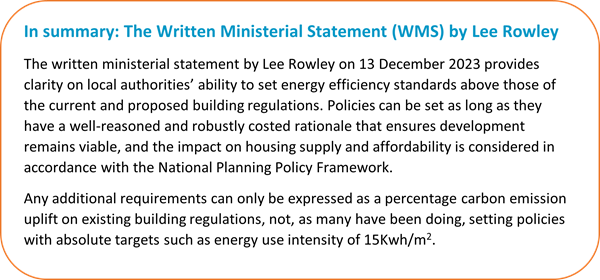
It has always been the case that planning policy evidence must demonstrate the costing rationalise for viability of development; the WMS reaffirms this. So, it’s business as usual for local authorities, to ensure that policies setting standards above Building Regulations comes with robust evidence that enables the economic viability of development.
The final test of the robustness of the plan level evidence base will ultimately be at the planning application viability appraisal. As long as the costing evidence base and viability model is correct, then all the policies will hold true.
The attention WMS has placed on development viability is a timely reminder that our collective net zero journey is bigger than just the energy efficiency of new homes.
The WMS provides a perfect point for reflection by local authorities to think bigger than just energy efficiency and look to the whole system of regional growth and infrastructure impacts emissions.
A whole systems approach to net zero policy
In our 2023 White Paper, Barriers to Net Zero we identified some of the barriers and opportunities to delivering net zero growth which are in the hands of local authorities such as skills and education, the impact of road building and planning with an ageing power infrastructure not ready for the electric led development. Such areas are rarely considered in net zero local planning policy as absolutes in the same way energy efficiency is.
This requires different thinking, especially on the impact of transportation emissions, which continues to be the UK’s largest sectoral emission.
The recent work developed by Stantec and the DecarboN8 network is an excellent starting point for this alternative thinking might look like.
Taking our queue from such research we want to see local plans that clearly articulates there is no need for high capital and carbon cost infrastructure such as roads to deliver required growth. Reducing high capital and carbon infrastructure frees money for what people need such as social housing, biodiversity, education, health and wellbeing, clean energy and energy efficient homes.
A whole systems thinking approach to carbon emissions would go some of the way to solving the restriction of the viability model on local energy efficiency standards. Is it time that the existing methods of defining viability created in a fossil fuel based economy are reinvented to reflect the climate emergency?
News topics
Aether Blog Air Pollution Air Quality Assessments Barriers to Net Zero Capacity Building Carbon Footprint Climate Emergency Climate Equality Climate Finance Consumption COP28 Culture Data Visualisation Economic Status Emissions Reporting European Topic Centre GHG Infrastructure Inventories Local Government Mitigation MRV National Government Net Zero Oxfam Paris Agreement Policy Recruitment Society Stakeholder Engagement Waste Sector Wider Impacts
Testimonial
Don't just take our word for it...
Contact us