+44 1865 259200
The Challenge
Because of their heavier weight and different braking systems freight trains require a longer stopping distance than passenger trains travelling at the same speed. However, the distance between railway signals is often designed for the required stopping distance of a passenger train, so freight trains have to travel at a lower speed to be able to stop in the same distance, and this reduction in speed is known as the ‘freight differential speed’. The reduced freight speeds can significantly increase running times and make it harder to path freight trains between passenger trains on the congested network. Freight differentials can be particularly restrictive in the Southern Region where the relationship between permissible freight speed and signalling design speed has been historically determined by the conservative “Two-Thirds Rule”.
Since the majority of freight differentials were set there have been significant improvements in the braking performance of freight trains. Modern locomotives have much better brakes and unbraked wagons have been largely eliminated. This means that current freight trains would be expected to have shorter stopping distances than were allowed for in the original differential speeds. There is therefore a case for reviewing the differentials and investigating whether there is an opportunity to increase them where the signal spacing permits, potentially resulting in improved timetables and better use of track capacity.
The Solution
RSSB commissioned the project T1348 Assessing the benefits of enhanced freight speed differentials on the GB network to identify criteria that a freight train must satisfy to travel safely at higher speeds and to assess the benefits of enhanced freight speeds if they can be safely accommodated.
Braking model
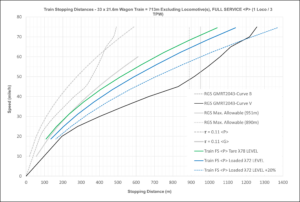
Railway Braking Associates and Carrickarory Consulting developed a sophisticated Excel-based model to calculate the required braking distance for a train on a specific section of route against a number of different parameters. These included train length, loaded and unloaded status, speed, and the widely used adjustment factors for train length and mass known as kappa and lambda. The model took account of the time taken to apply the brakes on each wagon along the consist, which can be responsible for up to 50% of the train’s stopping distance.
The model was developed in accordance with Railway Group Standard GMRT2045, Issue 4, March 2016, Compatibility Requirements for Braking Systems of Rail Vehicles and Railway Group Standard GKRT0075, Issue 5, December 2018, Requirements for Minimum Signalling Braking and Deceleration Distances.
The output from the model was a set of curves showing the relationship between required stopping distance and speed for a given train and load.
Signal spacing and speed comparison
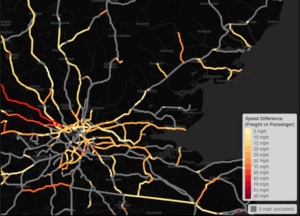
The required freight train braking distances calculated by the model were then compared with the signal spacing on the network, to identify where signal spacing would, in principle, support a reduced freight differential. The location and type of signal was obtained from Network Rail’s records and combined with a geographic model of the network. The model also had passenger and freight linespeeds added, and from this a comparison of the existing speed differentials could be displayed visually. This made it possible to easily identify the routes where the greatest benefit could be realised by removing or reducing freight speed differentials (i.e. the speed differentials are both large and affect a long distance). The area to the south and east of London was found to have multiple key freight routes where speed differentials apply to a significant proportion of route-km.
As well as considering route-specific opportunities to improve freight speeds, this project drew conclusions about the general relationship between signalling design speeds and permissible freight speeds.
Case study investigations
In practice the signal spacing, and corresponding speed limits, will vary along a route as train stopping distance varies with the gradient of the track and other constraints, such as infrastructure (e.g. curving track or level crossings). To assess whether enhanced freight speeds could be achieved in practice it is therefore necessary to investigate the factors that affect speed on specific routes.
Four case studies were considered in detail to better understand how practical freight speed limits (as determined by signal spacing and stopping distance) vary along a given route, also considering infrastructure constraints (such as track curvature) and network capacity (through timetable modelling):
- Barking to Stanford-le-Hope
- Ashford to Swanley
- Charlton to Lewisham via Sidcup and Slade Green
- Tonbridge to Dartford
For each case study the SRTcalc model developed for the RSSB T1302 and T1301 projects was used to calculate running times for defined trains using both existing and the proposed enhanced freight linespeeds. The revised timings were then compared with the current timetable to assess the potential for retiming or using different paths. In practice timetable improvements were small, largely because of conflicts with the passenger network and overcoming historic under-timings where no allowance had been given for the time taken for the full length of a train to clear a speed restriction. However, in places trains could depart later and arrive at the same time or run with a heavier load in the same path.
Workshops and implementation
Two stakeholder workshops were held to discuss the timing work with extensive representation from Network Rail, Train Operating Companies and Freight Operating Companies.
Implementation of the changes was discussed at the workshops, and the consensus was that a project had to be established within Network Rail to enable this. The proposal to increase freight linespeeds would need to involve a number of different Network Rail internal stakeholders.
Results
- Opportunities were identified for higher speeds on all of the case study routes, although the benefits are reduced in practice by local geographical and infrastructure constraints.
- In places trains could depart later and still arrive at the same time, run with a heavier load in the same path, or both. This allows improvements in reliability and resilience of the timetable and more efficient movement of goods on a per tonne basis.
- In the former Southern Region network there is considerable scope to exceed the freight operating speed defined using the ‘2/3rdrule’. In particular, no differentials are necessary at or below 50 mph and substantially smaller differentials than currently at 55 mph and above, equivalent to 85% of passenger speeds or better.
- A recommended improvement would be to introduce 5 km/h increments for the stopping distance calculation since, after rounding, speeds will align better with speed limits spaced in 5 mph increments. This would also minimise impacts from European Train Control System (ETCS) roll out.
- It is recommended that a project is established by Network Rail to implement these changes, which will require an update to the GMRT2045 and GKRT0075 RGS standards to provide a documented basis for any speed changes proposed.
For full details please see the RSSB report, Assessing the benefits of enhanced freight speed differentials on the GB network.
Mark Gibbs
Technical Director
Related case studies
News
Latest news
Posted on: 10 September 2026
Rail Freight Group award win
Aether were the winner in the Innovation category at the Rail Freight Group Annual Awards. The award recognises two RSSB research projects which are already delivering improvements for the rail freight sector.
Read full storyPosted on: 19 June 2026
NECD Review Week in Brussels
Aether spent a week at the European Commission in Brussels as part of the review of air pollutant inventories submitted under the EU’s National Emission reduction Ceilings Directive (NECD).
Read full storyPosted on: 18 May 2026
Power Query Workshop in Estonia
Aether travelled to the Estonian Environmental Research Centre (EKUK) in Tallinn to deliver a two-day training workshop for the inventory team to build capacity on the Excel power queries used in the GHG inventory templates previously set up by Aether in 2022.
Read full storyPosted on: 30 April 2026
Capacity Sharing in Saint Vincent and the Grenadines
Aether delivered a three-day GHG inventory capacity building workshop in Saint Vincent and the Grenadines, towards development of the BTR1.
Read full storyFilter news by category
Aether Blog Air Pollution Air Quality Assessments Barriers to Net Zero Capacity Building Carbon Footprint Climate Emergency Climate Equality Climate Finance Consumption COP28 Culture Data Visualisation Economic Status Emissions Reporting European Topic Centre GHG Infrastructure Inventories Local Government Mitigation MRV National Government Net Zero Oxfam Paris Agreement Policy Recruitment Society Stakeholder Engagement Waste Sector Wider Impacts
Testimonial