+44 1865 259200

The Challenge
Transporting freight by rail instead of road can offer reduced emissions, less congestion, and fewer accidents. However, freight trains are expensive to operate and can be difficult to path between passenger trains on Britain’s busy rail network. It is therefore beneficial if freight trains can operate with the maximum possible loads and to be timetabled with the quickest journey times that can be reliably achieved.
Railway timetables are planned using Sectional Running Times (SRT) between defined timing points (‘TIPLOCs’) on the network. SRTs are specified for different combinations of traction, wagon types and trailing load (the total weight of all wagons and their payload behind the locomotive). The maximum trailing load limits (TLLs) and SRTs can be calculated from consideration of the forces acting on a train: rolling resistances and aerodynamic drag, gravity on a slope, and the tractive force required to accelerate its mass.
TLLs have been defined using a historic British Rail document known as MT19, The manual of maximum train loads on gradients for various types of locomotives. It is estimated that MT19 came into use in 1967 and was last revised in 1989. Many of the currently-used SRTs and TLLs have not been updated for many years and the details of the original calculations have been lost. Furthermore, recently introduced locomotive classes and wagons have much better performance than older rolling stock, but this is not reflected in the available SRTs and TLLs. As a result, current SRTs are often found not to reflect observed performance, and TLLs are unnecessarily restrictive.
The Solution
To address industry concerns that SRTs and TLLs needed to be updated, RSSB commissioned two linked projects T1302: Guidance on limits of freight train trailing length as governed by tractive effort and T1301: Defining the case for optimising sectional running times for freight.
In the T1302 project the team reviewed historical documentation, international comparators, and the use of engineering principles to derive an empirical model using the Davis equation, which represents the relationship between the mechanical resistances and speed of a train as a quadratic equation:
𝑀𝑒𝑐ℎ𝑎𝑛𝑐𝑖𝑎𝑙 𝑅𝑒𝑠𝑖𝑠𝑡𝑎𝑛𝑐𝑒(𝑣) = 𝐴 + 𝐵×𝑣 + 𝐶×𝑣2
where 𝑣 is the train speed and the coefficients A, B, C are characteristics of the locomotives and wagons in the consist. The model successfully reproduced the original MT19 calculations and can be updated with more recent data for wagons and newer locomotives. The new model was further developed, using the coding language ‘R’, to make use of improved geographical data available from Network Rail, and also to take account of train length. This model, ‘SRTcalc’, calculates timings along a route as well as load limits.
In the T1301 project the team built on the improved SRT calculation methodology through analysis of five case studies, leading to further refinements in the methodology and calculation of improved resistance coefficients for a wider range of rolling stock. In discussion with rail industry stakeholders, five routes were identified that represent typical challenges found at key locations on the rail freight network. The ‘SRTcalc’ tool was used to calculate new running times for selected trains on the case study routes using both the existing Network Rail equations and the updated formula derived for the T1302 project. D2 Global then used the ATTune timetable model to investigate whether any improvements in the calculated running times could be used to achieve improved journey times in the timetable, for example by making it possible for the train to take an earlier path.
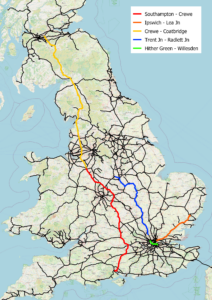
The five case study routes were:
- Southampton to Crewe
- The Great Eastern Main Line from Ipswich to London
- The West Coast Main Line from Crewe to Coatbridge, including Grayrigg and Shap Summits
- The Midland Main Line from Trent Junction to Radlett
- The West London Line from Latchmere Junction to Hither Green
In a follow-up project for Network Rail (T1301 Phases 2 and 3) the updated model was used to inform timetable revisions for freight routes in Wales. Opportunities were identified to improve the timetable, taking advantage of the performance of more modern traction and correcting for inaccuracies in older data. This work provided a further opportunity to further optimise the model by testing it on a wider range of geographies, loads and rolling stock.
Results
The principal findings of the research are that improved SRT calculations offer the following benefits:
- Timings can generally be improved, reducing end-to-end journey times.
- Where timings are based on incorrect or out of date assumptions (e.g. old linespeeds) a more accurate calculation will lead to a reduction in delay minutes.
- Heavier trains can be run within the existing timings.
- Electric timings can be significantly improved.
Modelled SRTs compared with current timings on the Shrewsbury–Dee Marsh route:
| Consist | Calculation methodology | Reduction in running time over 90-minute journey | Percentage reduction |
| Class 66 (2,200 tonnes) | Network Rail | 14 mins 22 secs | 16% |
| Class 66 (2,200 tonnes) | T1302 | 16 mins 48 secs | 19% |
| Class 70 (2,200) | T1302 | 20 mins 31 secs | 23% |
Performance of different locomotives over Shap:
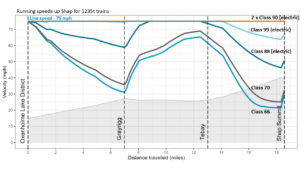
Improved journey times make rail freight more competitive with road haulage and allow more efficient utilisation of the congested network, whilst longer loads reduce the unit costs, also improving competitiveness. There are also network performance benefits from more accurately calculated SRTs: journey times will be more predictable and timetables more resilient and better able to recover from disruption. While retiming is generally constrained by passenger traffic, ‘stepping up’ to use a path before the currently preceding passenger train is sometimes possible.
An additional benefit of this research was that the modelling process helped to identify incorrect infrastructure and/or routing assumptions which can impact the accuracy of timetable planning.
The work undertaken in the T1301 project enabled further improvements to be made to the ‘SRTcalc’ model, and the resistance coefficients and traction performance data developed in T1301 have been used to inform other modelling work used by the rail industry. This includes the Speed, Energy and Emissions Simulator (SEEsim) (formerly known as the Railfreight Energy & Emissions Calculator or REEC), which is being used by freight operators to optimise their timetables, such as for Freightliner’s aggregate trains from the Mendip quarries.
The T1302 project also informed the development of an online tool for calculating Network Rail’s Digital Freight Loads Books (DFLB) which calculates the maximum permitted trailing loads for freight trains for each traction type and section on the network. Aether supported Railwhere in the development of the DFLB.
Reports:
- Guidance on limits of freight train trailing length as governed by tractive effort (T1302)
- Defining the case for optimising sectional running times for freight (T1301-Phase 1)
- Modelling sectional running times over three rail freight routes in Wales (T1301-Phases 2 and 3)
“This is really helping us improve the performance of freight services whilst increasing opportunities to grow rail freight across Wales & Borders Route—all of which supports our local economies and accelerates the drive to reduced carbon emissions.”
– Josh Bliszko, Programme Manager, Network Rail Wales & Border
Mark Gibbs
Technical Director
Related case studies
News
Latest news
Posted on: 10 September 2026
Rail Freight Group award win
Aether were the winner in the Innovation category at the Rail Freight Group Annual Awards. The award recognises two RSSB research projects which are already delivering improvements for the rail freight sector.
Read full storyPosted on: 19 June 2026
NECD Review Week in Brussels
Aether spent a week at the European Commission in Brussels as part of the review of air pollutant inventories submitted under the EU’s National Emission reduction Ceilings Directive (NECD).
Read full storyPosted on: 18 May 2026
Power Query Workshop in Estonia
Aether travelled to the Estonian Environmental Research Centre (EKUK) in Tallinn to deliver a two-day training workshop for the inventory team to build capacity on the Excel power queries used in the GHG inventory templates previously set up by Aether in 2022.
Read full storyPosted on: 30 April 2026
Capacity Sharing in Saint Vincent and the Grenadines
Aether delivered a three-day GHG inventory capacity building workshop in Saint Vincent and the Grenadines, towards development of the BTR1.
Read full storyFilter news by category
Aether Blog Air Pollution Air Quality Assessments Barriers to Net Zero Capacity Building Carbon Footprint Climate Emergency Climate Equality Climate Finance Consumption COP28 Culture Data Visualisation Economic Status Emissions Reporting European Topic Centre GHG Infrastructure Inventories Local Government Mitigation MRV National Government Net Zero Oxfam Paris Agreement Policy Recruitment Society Stakeholder Engagement Waste Sector Wider Impacts
Testimonial