+44 1865 259200
The Challenge
Idling – when the engine is running but not generating tractive power – occurs when a diesel train is coasting or braking, and also when stationary in stations, stabling locations or depots. Diesel trains have one or more idle modes where the engine operates at a relatively low engine speed (revolutions per minute, rpm). A substantial part of a diesel train’s drive cycle can be spent in idle.
Although emissions of the air quality pollutants nitrogen oxides (NOx) and particulate matter (PM) in idle are lower per unit time (g/h) than in other engine notches, they are highest on a power basis (g/kWh). Consequently, idling emissions can have a disproportionately higher impact on air quality compared to other parts of the drive cycle.
Emissions during idling may only be a small part of the total mass of emissions generated throughout the overall drive cycle of a train. However, they may be particularly important at key locations with existing air quality issues where concentrations of air quality pollutants are close to breaching an existing ambient air quality objective or potential rail air quality target.
Reducing idling has numerous benefits:
- It reduces the amount of diesel fuel used and saves money.
- It reduces exhaust emissions, which improves the air quality in the local area and reduces the societal costs of air pollution and carbon emissions.
- It reduces the impact of noise on staff and neighbours.
- It can lead to a reduction in maintenance costs as engines are running less, which may allow for longer time periods between servicing.
However, at many locations idling may be necessary to produce power for hotel loads (such as heating or cooling), brake compressors and other auxiliaries, including when the driver prepares the train for departure. Unavoidable idling also occurs while waiting at a stop signal: engines need to be kept running to ensure the train can move off as soon as it is allowed to proceed. In addition, there is little benefit in shutting down engines for stops that are less than 10 minutes. It was therefore necessary to distinguish between unavoidable and avoidable idling in this project.
The need to address idling emissions is recognised in the rail industry Air Quality Strategic Framework and Sustainable Rail Blueprint. It is also included in the 2022 Chief Medical Officer’s annual report. To meet this challenge RSSB contracted Aether to quantify when and where idling takes place, to investigate why idling occurs, and to develop guidance on how it can be reduced.
The Solution
To quantify potential avoidable idling and identify where it occurs, on-train monitoring data was obtained from a number of train operating companies (TOCs) operating diesel trains and the owning rolling stock leasing companies (ROSCOs). The data varied considerably in the parameters measured and data formats used, so significant pre-processing was required. All of the data included time of day and vehicle speed. Some of the data included GPS location data that could be used to identify the stop location, while some of the data included engine speed. Where engine speed was missing, other indicators were used to determine whether the engines were running, such as the battery voltage or the data logging frequency.
Vehicle speed and location data (where available) was used to identify where the train had stopped, and the locations were categorised by station (terminating or through), depot (including stabling locations) or network (stops at signals etc.). Longer stops over 10 minutes were identified as a threshold for identifying potential avoidable idling. Stopping rates were then determined at stations and at depots. Using the time distributions of these prolonged stops, typical potential avoidable idling rates (in minutes per 1000 vehicle-km) were derived.
The Results
The analysis of the data from the different train classes and operators showed a large variation in the amount of idling occurring. Some trains were left idling while stationary for about half of the day, whereas others were left idling for about a quarter of the day. Some idling events exceeded 12 hours.
The figure below shows an illustrative example of data collected from two diesel multiple units (DMUs) in routine operation for about a month. This included running scheduled timetables, overnight stabling, and time in depots. The data has been analysed to determine the amount of time in four different modes:
- Stationary – Engine OFF: the train is stationary and all its engines have been shut down.
- In Motion – Under Power: the train is in motion and traction power is applied to the wheels (i.e. notch position is greater than zero).
- In Motion – Coast/brake: the train is in motion and either coasting or braking. No traction power is applied to the wheels (i.e. notch is in the zero position).
- Stationary – Engine ON: the train is stationary and the engines are running.
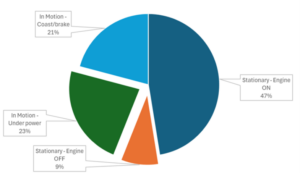
By extrapolating average potential avoidable idling rates for different fleets using annual vehicle-km figures, the total annual avoidable idling nationally was estimated to be over 2 million hours, split almost equally between terminating stations and depots. The associated societal carbon and air pollution damage annual costs were calculated to be about £24 million for CO2 emissions, and over £10 million each for NOx and PM emissions. The cost of the fuel used during potentially avoidable idling is over £20 million per year, which represents about 8.5% of the national diesel train fuel usage.
Due to high variability across rolling stock, routes, and operations, it is impossible to prescribe a single solution to reduce avoidable idling. TOCs must understand their own situation to determine where and why idling happens and how much is avoidable. With this information, TOCs will be able to assess the most practical, effective solutions that will address the biggest issues.
TOCs are therefore encouraged to develop idling reduction strategies and to include them in air quality improvement plans. The findings from the research were used to draft guidance for the industry, which sets out the following recommended approach:
- Develop data analysis capability to ensure that engine running data and train speed and location data are available to help develop solutions
- Identify potential avoidable idling by analysing locations and durations of idling
- Understand the causes; these could be because of behavioural, operational or technical issues
- Develop effective idling reduction approaches that are class and route specific
- Target interventions by considering sensitive locations and cost-effective interventions
- Develop idling key performance indicators (KPIs) against which improvement can be tracked
- Track progress to enable wider implementation of interventions or development of new approaches.
The detailed guidance is set out in the RSSB publication Good Practice Guide: Reducing Emissions From Idling Diesel Trains.
Further information is available on the RSSB website.
Mark Gibbs
Associate Director
Related case studies
Luton Council Net Zero Roadmap and Climate Policy and Action Plan
Category: Cities and Local Authorities
Aether, alongside SE2 and associate Joanne Wade, developed a Net Zero Roadmap and Climate Policy and Action Plan to support the council in its vision of a net zero town by 2040.
Read case studyMerton Council Climate Emergency Support
Category: Cities and Local Authorities, Emission Inventories, Policies and Measures
Aether and SE2 supported Merton Council in developing their action plan to meet targets to decarbonise the Council by 2030 and the borough of Merton by 2050
Read case studyCity of London Air Quality Data Visualisation
Category: Cities and Local Authorities
Aether developed an online, interactive data visualisation for the City of London that could be used by policy makers and the general public to explore data and information on air quality. Topics covered include air pollutant emissions, bus fleet emission control technologies and the health impacts of air pollution.
Read case studyNews
Latest news
Posted on: 17 March 2026
Central Asia Study Tour: Air Quality Workshop
Aether provided representatives from Central Asia (Kyrgyzstan, Tajikistan, Turkmenistan, Uzbekistan and Kazakhstan) who were visiting the UK on a study tour with an introduction to air quality management.
Read full storyPosted on: 13 January 2026
Devolved Governments Air Pollutant Emissions Inventories
The air pollutant emissions inventories for England, Scotland, Wales, and Northern Ireland were published in September 2025. The data covers the period 2005 to 2023, for the pollutants ammonia, carbon monoxide, nitrogen oxides, non-methane volatile organic compounds, PM10, PM2.5, sulphur dioxide, and lead.
Read full storyPosted on: 11 December 2025
Aether provided training to strengthen Government of Jersey’s climate policy modelling capacity
Aether completed a project for to train staff in Government of Jersey in using Aether's Carbon Scenario Model to quantify the carbon impacts of net zero policies. The model is a key tool for the Government of Jersey for informing policy decisions on climate actions, and other related policies.
Read full storyPosted on: 6 October 2025
Aether Experts Contribute to IPCC Report on Short-Lived Climate Forcers
In the first week of October Richard Claxton and Sergii Shmarin were in Istanbul, contributing as lead authors to the upcoming IPCC Methodology Report on Short-Lived Climate Forcers (SLCFs). SLCFs - such as black carbon, and other ozone precursors play a critical role in climate change and air quality. The new methodology report will provide essential guidance for countries to improve their emissions inventories and strengthen climate action.
Read full storyFilter news by category
Aether Blog Air Pollution Air Quality Assessments Barriers to Net Zero Capacity Building Carbon Footprint Climate Emergency Climate Equality Climate Finance Consumption COP28 Culture Data Visualisation Economic Status Emissions Reporting European Topic Centre GHG Infrastructure Inventories Local Government Mitigation MRV National Government Net Zero Oxfam Paris Agreement Policy Recruitment Society Stakeholder Engagement Waste Sector Wider Impacts
Testimonial