+44 1865 259200
The Challenge
The European Union has set emission reduction targets for greenhouse gases. A key contribution to meeting these targets comes from the land use, land use change and forestry (LULUCF) sector, where land use activities can result in emissions and removals of CO2. A robust accounting system is needed to ensure that the emissions and removals are estimated using acceptable methods.
Emissions and removals from managed forest land are accounted against a Forest Reference Level (FRL). Forest reference levels are forward-looking benchmarks that quantify net emissions from the existing forests in each EU country. The aim is to estimate natural fluctuations in net emissions from forests so that only the anthropogenic impacts of management practices are accounted for. They are based on a continuation of sustainable forest management practices from the period 2000-2009. They draw on the best available data and take into account dynamic age-related forest characteristics.
EU Member States submitted their National Forestry Accounting Plans (NFAP), including a proposed forest reference level, by 31 December 2018 for the period from 2021 to 2025. Any revisions to the proposed FRLs were communicated to the Commission by 31 December 2019.
The Solution
The EU LULUCF Regulation requires the European Commission to undertake a technical assessment of the NFAPs to evaluate the extent to which the proposed FRLs have been determined in accordance with the principles and requirements of this regulation. For this, a LULUCF Expert Group was formed with individual experts, civil organisations, Member State authorities and other public entities (Iceland, Norway and the EFTA Surveillance Authority).
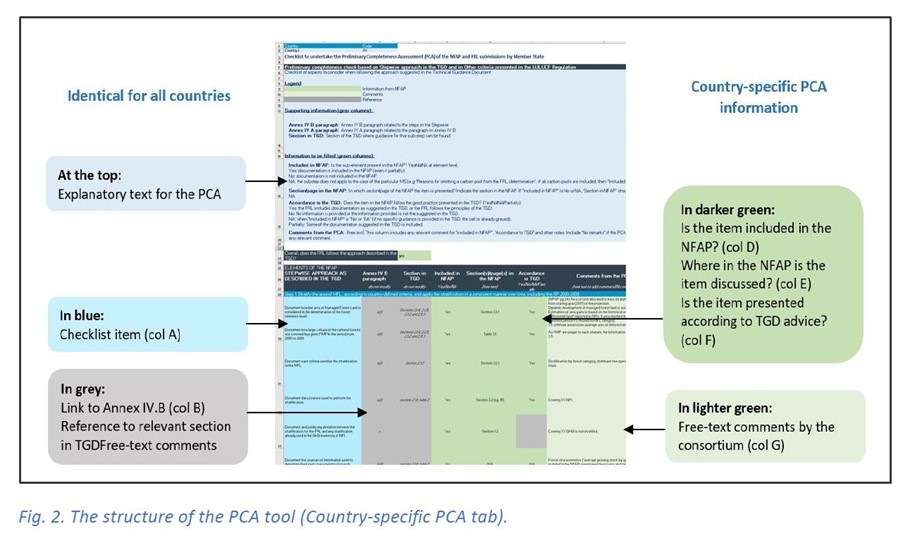
Aether, in partnership with ICF and IIASA, supported the European Commission and the LULUCF Expert Group in the technical assessment of the NFAPs. The work covered a wide remit, including process planning and management, the development of assessment guidance and tools, training the LULUCF Expert Group in the use of these tools, carrying out completeness assessments for each NFAP, compiling summary tables, and carrying out consistency checks between FRL proposals and GHG inventories for several Member States.
The Result
National Forestry Accounting Plans, including forest reference level proposals, are a fundamental tool for policy formation, as they provide a reference of the forest situation based on historical management practices. They will also be used by Member States to formally demonstrate actions which enhance forest management, leading to increased carbon sequestration and decreased GHG emissions. It is important that the quality of the estimates is understood and are demonstrated to be of sufficient quality.
In the context of the LULUCF Regulation, it is only with sufficiently complete and reliable NFAPs and FRL proposals that Member States and the European Commission can adopt robust climate change policies and review the progress of existing policies. In October 2020, the European Commission adopted the FRLs for each Member State.
Aether’s detailed technical knowledge in the forestry sector ensured highly effective support of the FRL assessment process for the European Commission. In addition, Aether provided technical and project management assistance to the EFTA Surveillance Authority throughout the process of establishing the FRLs for Iceland and Norway. In December 2020, the EFTA Surveillance Authority adopted its decision on the Forest Reference Levels for both countries.
Chris Dore
Director
Related case studies
Support to the European Environment Agency
Category: International Organisations, Emission Inventories, Policies and Measures
Aether has been providing support to the European Environment Agency through their European Topic Centres since 2014, focussing on air pollution, industrial pollution and climate change mitigation.
Read case studyElectric vehicles from life cycle and circular economy perspectives
Category: International Organisations, Policies and Measures
A report written for the European Environment Agency that used an extensive literature review to analyse and synthesis the environmental impacts of electric vehicles though life cycle and circular economy perspectives.
Read case study2019 Refinement to the 2006 IPCC Guidelines
Category: International Organisations, Emission Inventories
Justin Goodwin, Director at Aether, worked as part of a multi-national team on the 2019 Refinement of the 2006 IPCC Guidelines for National Greenhouse Gas Inventories.
Read case studyNews
Latest news
Posted on: 10 September 2026
Rail Freight Group award win
Aether were the winner in the Innovation category at the Rail Freight Group Annual Awards. The award recognises two RSSB research projects which are already delivering improvements for the rail freight sector.
Read full storyPosted on: 19 June 2026
NECD Review Week in Brussels
Aether spent a week at the European Commission in Brussels as part of the review of air pollutant inventories submitted under the EU’s National Emission reduction Ceilings Directive (NECD).
Read full storyPosted on: 18 May 2026
Power Query Workshop in Estonia
Aether travelled to the Estonian Environmental Research Centre (EKUK) in Tallinn to deliver a two-day training workshop for the inventory team to build capacity on the Excel power queries used in the GHG inventory templates previously set up by Aether in 2022.
Read full storyPosted on: 30 April 2026
Capacity Sharing in Saint Vincent and the Grenadines
Aether delivered a three-day GHG inventory capacity building workshop in Saint Vincent and the Grenadines, towards development of the BTR1.
Read full storyFilter news by category
Aether Blog Air Pollution Air Quality Assessments Barriers to Net Zero Capacity Building Carbon Footprint Climate Emergency Climate Equality Climate Finance Consumption COP28 Culture Data Visualisation Economic Status Emissions Reporting European Topic Centre GHG Infrastructure Inventories Local Government Mitigation MRV National Government Net Zero Oxfam Paris Agreement Policy Recruitment Society Stakeholder Engagement Waste Sector Wider Impacts
Testimonial